
material strength
Many materials of a structure are subjected to loads during use, such as the wings of airplanes and the shafts of automobiles. Under load conditions, it is necessary to know the characteristics of the material used so that the resulting deformation is not excessive and failure does not occur. The mechanical behavior of the material is a response to the applied load. The mechanical properties of the material can be determined by conducting tests taking into account the loading conditions, duration and environmental conditions which are arranged in such a way that they are close to their original conditions.
The mechanical behavior of the material can be determined by stress-strain testing, this test is often carried out for testing metals at room temperature. The test is carried out by applying a static load or a load that changes relatively slowly with time (quasi-static) on a cross section of the surface of the structural member. The results of these tests are engineering stress and engineering strain. Engineering stress (σ) is defined as the load (F) applied perpendicular to the cross-sectional area of the specimen (F/A0) with units of MPa or psi. Engineering strain (ε) is defined as the ratio between the increase in length due to loading (∆l) with the initial length of the specimen (l), engineering strain (ε) has no dimensions.
Material that is given a load will experience deformation, can experience elastic deformation or also plastic deformation. Elastic deformation is a non-permanent deformation which means that when the load is removed the material returns to its original shape, where the stress and strain are proportional to form a linear relationship. The gradient of the linear line is the modulus of elasticity (E). The modulus of elasticity is the stiffness property of the material or the resistance of the material to elastic deformation, the greater the modulus of elasticity the stiffer the material and vice versa. Plastic deformation is permanent deformation of the material, even when the load is removed. In plastic deformation, yielding phenomenon occurs, namely where there is a transition between elastic and plastic deformation. The measured stress when the yielding phenomenon occurs is called yield strength. After yielding occurs, the stress continues to increase to a maximum to continue plastic deformation. Tensile strength is the maximum stress that a material can withstand.

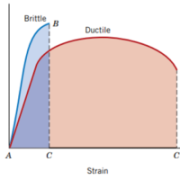
Ductility of a material is a material property that has the ability to undergo strain before fracture. Ductile materials usually undergo plastic deformation and reduction in cross-sectional area when fracture occurs and the necking phenomenon occurs. The fracture surface of the ductile material forms a cup and cone.
The brittleness of a material shows the properties of a material that does not undergo plastic deformation before fracture occurs. Brittle material breaks suddenly, does not experience strain, does not stretch before fracture and does not decrease in cross-sectional area before fracture. The fracture surface of a brittle material is usually flat.

Contributor: Feri Wijarnako

material fatigue
Fatigue is a material damage caused by repeated loading for a long time. If a metal is subjected to repeated loads (stress or strain), the metal will fracture. Damage due to repeated loads is called fatigue failures, generally this occurs after the use of the material for a long time. The damage occurs without warning, suddenly, and completely. More than 90% of the causes of mechanical failure are caused by fatigue fracture.
Phases in Fatigue Fracture:
- Initiation crack
- Crack propagation
- Fracture failure

In general, the process of crack initiation occurs on the surface of the weak material or areas where there is a concentration of stress on the surface, such as scratches, notches, holes, etc., due to repeated loading. Furthermore, the beginning of these cracks develops into microcracks, the propagation or combination of these microcracks then forms macrocracks which will lead to failure. After that, the material will experience a final fracture, because the material has undergone a stress and strain cycle that results in permanent damage.
Basically, fatigue failure begins with the occurrence of cracks on the surface of the material. It proves that fatigue properties are very sensitive to surface conditions, which are influenced by several factors, including surface roughness, changes in surface properties, and surface residual stress. Therefore, the endurance limit is highly depends on the quality of the surface finish. Surface treatment may change the surface condition and residual stress on the surface. Surface treatment that produces compressive residual stress will result in increased fatigue resistance, while surface treatment that produces tensile residual stress will decrease its fatigue resistance.
At the surface of the material the highest concentration of compressive or tensile stress occurs. If the surface conditions are receiving tensile stresses, the residual compressive stress on the surface will result in a greater resultant compressive stress. The compressive stress will inhibit the initiation of crack, so that the fatigue resistance will increase, and the opposite will happen if there is residual tensile stress on the surface. The initial location of cracks in components or metals that are subjected to dynamic or cyclic loading is at the point of the region that has the minimum strength and or the point of the region experiencing the maximum stress.
Failure of components or structures can be divided into two main categories. First, quasi-static failure (failure that does not depend on time, and resistance to failure is expressed by strength). Second, time-dependent failure (resistance to failure is expressed by age or life time). Metal fatigue (fatigue fracture) is included in the time-dependent failure.
Factors Affecting Metal Fatigue
- Loading
- Load type: uniaxial, bending, torsion
- Load pattern: periodic, random
- Load amount
- Load cycle frequency
- Material condition (grain size, strength, solid solution reinforcement, second phase reinforcement, strain reinforcement, microstructure, surface finish), component size).
- Working process (casting process, forming process, welding process, machining process, heat treatment process)
- Operating temperature
- Environmental conditions

Contributor: Feri Wijarnako

aeroengineering services is a service under CV. Markom with solutions especially CFD/FEA.