
Onshore and offshore facilities
In learning about oil and gas, we must often hear the terms onshore and offshore. So, what do these two terms mean? Let’s discuss!
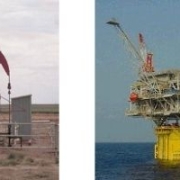
Onshore is work on land to shoreline areas for oil and gas exploration and exploitation activities. Examples of onshore work are onshore refineries and boreholes.
While offshore means work that is far from land or at sea. Offshore is an oil and gas exploration and exploitation activity carried out offshore or far from land. In offshore activities, exploration and exploitation are carried out using a platform structure installed in the middle of the ocean to support the equipment.
Onshore

Onshore production can produce more than a few tens of barrels a day. Oil and gas are produced from several million wells worldwide. For the smallest reservoirs, petroleum is collected in holding tanks and collected in tanker trucks or railcars for processing in oil refineries.
Onshore wells in oil-rich areas also have high-capacity wells producing thousands of barrels per day, connected to 1,000,000 barrels per day oil separation plants. Products are shipped from the factory by pipelines or tankers. Oil and gas production comes from many different licensees.
Recently, crude oil, tar sands and oil shale have been extracted with the latest technology and lower prices. In the extraction process, crude oil needs heating and diluent to be extracted, tar sand is extracted using steam. Oil reserves in unconventional reservoirs contain more than twice the hydrocarbons found in conventional reservoirs.
Offshore

The installation of offshore structures depends on the size and depth of the water. Some types of offshore structures that are often used are:
Shallow water complex. This structure is characterized by several independent platforms with various parts of the process and equipment connected by small bridges.
Gravity Base. A very large concrete structure is placed at the bottom. This structure accommodates all parts of the process and a large number of equipment. The structure is formed using cast concrete that is worked on the beach. Then, the structure is filled with sufficient air so that the structure floats in the sea and is carried to the middle of the sea and then planted to the seabed.
Compliant towers. Very similar to gravity base. It’s just that the shape is smaller like a narrow tower. The tower is flexible. This flexibility allows it to operate in much deeper water as it can ‘absorb’ much of the pressure exerted on it by wind and sea. The tower is used in water depths of 500 to 1000 meters.
Floating production. This structure is a structure that floats on the surface of the sea. Three examples that are often used are Floating Production, Storage and Offloading (FPSO), Tension Leg Platform (TLP) and SPAR.
FPSO is an offshore platform using large ships. The ship can rotate freely around following the direction of the wind, waves or currents. The process is placed on the ship’s deck, while the hull is used for storage and discharge of goods to the dock. It can also be used with pipeline transportation. FPSO operates at sea level at a depth of 200 -2000 meters.
The TLP consists of structures held in place by vertical tendons connected to the seabed. The structure is held in place by tensioned tendons that support the use of TLP in wide waters of depths ranging up to 2000m. The tendons are constructed with hollow high tensile strength steel tubing which brings spare buoyancy to the structure and ensures limited vertical movement.
The SPAR consists of one large tall cylinder that supports the deck (process site). However, the cylinder cannot cover the entire deck, instead it is added support material with a series of cables and beams. The large cylinder serves to stabilize the platform in the water and absorb the potential force of the storm. SPAR is used at water depths from 300 and up to 3000 meters. SPAR is not an acronym, but refers to its resemblance to a spar ship. SPARs can support dry wells, but are more commonly used in subsea wells.
Subsea production systems. Wells located on the seabed, not at sea level. Like floating production systems, petroleum is extracted on the seabed, and then it can be connected to existing production platforms or even land facilities. The wells are drilled by mobile rigs and the extracted oil and gas is transported by subsea pipelines and sent to processing facilities. Underwater systems are typically used at depths of 7,000 feet or more and have no drilling capability, only for extracting and transporting. Drilling and processing is carried out from the surface.
Contributor: Daris Arsyada
References:
Devold, Havard. 2006. Oil and Gas Production Handbook: An Introduction to Oil and Gas Production. Oslo: ABB ATPA Oil and Gas.

main processes of oil and gas production
The oil and gas industry is one of the industries that demands highly engineered and varied processes. In this article, we will discuss some of the most common processes encountered in the oil and gas production process.

Wellheads
The wellhead is above the actual oil or gas well leading to the reservoir. The wellhead can also be an injection well, used to inject water or gas back into reservoir to maintain pressure and level to maximize production. This process consists of reinforcing the wellbore with a casing, evaluating the formation pressure and temperature, and then installing the appropriate equipment to ensure an efficient flow of natural gas out of the well. Well flow is controlled by a choking device.
Manifolds/gathering
Onshore – The well flow is brought to the main production facility via a pipeline collection network and manifold system. The aim is to regulate production so that production levels increase, utilize the reservoir as well as possible, adjust the composition of the well flow (gas, oil, etc.) appropriately.
Offshore – Dry completion of the well in the central main field feeds directly to the production manifold, while the outer wellhead tower and subsea installation feed via multiphase pipelines back to the production rungs. A riser is a system that allows the piping to “go up” to the superstructure. To float a structure, this involves taking the weight of the structure and moving it. For heavy crude oil, diluents and heating may be required to reduce viscosity and facilitate flow rates.
Separation
Some wells have pure gas production which can be taken directly to gas treatment and/or compression. More often, wells consist of a combination of gas, oil and water and various contaminants must be separated and processed. The production of separators comes in various shapes and designs.
Gas Compression
The gas from the pure gas well has sufficient pressure to be supplied directly to the pipeline transport system. The gas from the separator generally loses so much pressure that it must be compressed to be transported. The turbine compressor benefits their energy by using a fraction of the compressed natural gas. The turbine functions to operate a centrifugal compressor, which contains a type of fan that compresses and pumps natural gas through pipes.
Metering, Storage and Export
Metering on oil and gas are at the measurement site which aims to measure several variables of oil and gas fluid flow in the pipeline. The quantities observed in the pipe are pressure, temperature, fluid level, flow rate.
Most industries do not allow local storage of gas, but oil is often stored before loading on ships, such as shuttle tankers that carry oil to larger tanker terminals, or directly to crude carriers. Offshore production facilities without pipelines rely on storage of crude oil in the ship’s bottom or hull, to allow a shuttle tanker to offload goods about once a week. More complex productions generally have tank warehouses that store more crude oil to deal with changes in demand, transportation delays, etc.
The processes above are closely related to fluid mechanics. One of the most common methods for designing a system of production processes in the oil and gas industry is to use Computational Fluid Dynamics (CFD), which is a method of solving fluid mechanics equations and even chemical reactions using a computer, so that comprehensive and detailed results are obtained. >> Click here to learn more about CFD!
Contributor: Daris Arsyada

aeroengineering services is a service under CV. Markom with solutions especially CFD/FEA.
References:
Devold, Havard. 2006. Oil and Gas Production Handbook: An Introduction to Oil and Gas Production. Oslo: ABB ATPA Oil and Gas.