
How Data Center HVAC Works
Data center HVAC systems are designed to maintain precise environmental conditions that ensure reliable operation of IT equipment such as servers, storage systems, and networking hardware. Unlike typical building HVAC systems that prioritize human comfort, data center cooling focuses on removing large amounts of heat generated by electronic equipment while maintaining strict control over temperature, humidity, and airflow distribution.
At the core of a data center HVAC system is the continuous removal of heat produced by servers. As electrical energy is consumed by IT equipment, nearly all of it is converted into heat. If not properly managed, this heat can lead to equipment failure, reduced lifespan, and system downtime. To address this, cooling systems such as Computer Room Air Conditioning (CRAC) units or Computer Room Air Handling (CRAH) units are used to regulate temperature within the data center.
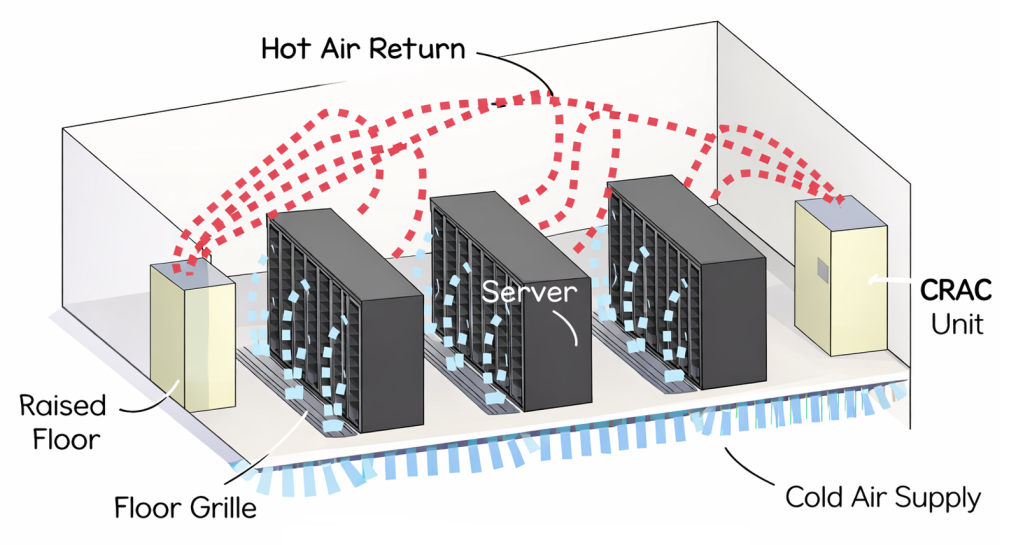
One of the most common cooling strategies is the hot aisle/cold aisle configuration. In this setup, server racks are arranged so that cold air is supplied to the front (cold aisle) where servers intake air, and hot air is expelled at the back (hot aisle). This separation helps prevent mixing of hot and cold air, improving cooling efficiency. In more advanced designs, containment systems are used to physically isolate hot or cold aisles, further enhancing performance.
Airflow management is critical in data centers. In many facilities, a raised floor system is used to distribute cold air from CRAC/CRAH units through perforated tiles placed strategically in front of server racks. The air passes through the equipment, absorbs heat, and is then returned to the cooling units. In modern designs, overhead cooling or in-row cooling systems are also used to deliver cooling more directly to high-density equipment.
Humidity control is another important aspect of data center HVAC. If humidity is too low, it can increase the risk of electrostatic discharge, which can damage sensitive electronics. If it is too high, condensation may occur, leading to corrosion or short circuits. Therefore, HVAC systems maintain humidity within a controlled range, typically using humidifiers and dehumidifiers integrated into the system.
In addition to traditional air-based cooling, many data centers are adopting advanced cooling technologies such as liquid cooling. This includes direct-to-chip cooling, where coolant is circulated directly to heat-generating components, and immersion cooling, where servers are submerged in a thermally conductive liquid. These methods are particularly useful for high-performance computing environments with very high heat densities.
Energy efficiency is a major concern in data center HVAC design. Cooling systems can account for a significant portion of total energy consumption. Metrics such as Power Usage Effectiveness (PUE) are used to evaluate efficiency, encouraging designs that minimize energy use while maintaining performance. Techniques such as free cooling (using outside air), economizers, and optimized airflow management are commonly implemented to reduce energy demand.
To optimize these complex systems, engineers often use Computational Fluid Dynamics (CFD) to simulate airflow, temperature distribution, and hotspot formation within the data center. With tools like tensorHVAC-Pro, detailed analysis can be performed to improve rack placement, airflow strategies, and cooling system design. This ensures reliable operation, reduces energy consumption, and supports the growing demand for high-performance data processing infrastructure.