
Thermal Comfort and Air Age Simulation using tensorHVAC-Pro
Designing a comfortable indoor environment requires more than estimating airflow rates or setting target temperatures. True thermal comfort depends on how air moves, how heat is distributed, and how occupants physically experience the environment. With tensorHVAC-Pro, engineers can evaluate all of these factors using physics-based CFD simulation, allowing design decisions to be validated before construction or installation begins.
Air velocity is one of the most fundamental parameters in HVAC analysis because it determines how air circulates within a space. In tensorHVAC-Pro, velocity fields are visualized through streamlines and contour plots, making it easy to identify airflow patterns, dead zones, and areas of excessive speed. Low velocities can lead to stagnant air and poor ventilation, while high velocities may cause uncomfortable drafts. By analyzing velocity distribution, engineers can optimize diffuser placement and airflow rates to achieve balanced and comfortable air movement throughout the occupied zone.

Temperature distribution plays an equally important role in comfort assessment. Even when the average room temperature meets design targets, uneven distribution can result in localized hot spots or cold regions. tensorHVAC-Pro provides detailed temperature contour maps that reveal how heat spreads and stratifies within a space. This is particularly important in large rooms or spaces with significant heat loads, where vertical temperature gradients can form. By visualizing these effects, engineers can refine HVAC layouts to ensure uniform thermal conditions and avoid discomfort.
To translate physical conditions into human perception, tensorHVAC-Pro calculates thermal comfort indices such as Predicted Mean Vote (PMV). PMV represents how occupants are likely to perceive the thermal environment on a scale from cold to hot. A value near zero indicates neutral comfort, while deviations toward negative or positive values indicate cold or warm discomfort. Instead of relying on assumptions, engineers can directly observe PMV distribution across a space and verify whether the design meets established comfort standards.
Closely related to PMV is the Predicted Percentage of Dissatisfied (PPD), which estimates the proportion of occupants likely to feel uncomfortable. Even in well-designed environments, a small percentage of dissatisfaction is unavoidable, but maintaining low PPD values is critical for acceptable indoor conditions. tensorHVAC-Pro allows engineers to visualize PPD alongside PMV, making it easier to identify problematic zones and quantify the overall performance of the HVAC system.
Another important factor is draft rate (DR), which quantifies discomfort caused by unwanted air movement. Draft discomfort often occurs near diffusers or in areas where airflow accelerates unexpectedly. tensorHVAC-Pro evaluates draft rate based on local velocity, turbulence, and temperature, highlighting regions where occupants may feel excessive cooling from moving air. This enables engineers to fine-tune airflow distribution and avoid common design issues related to drafts.
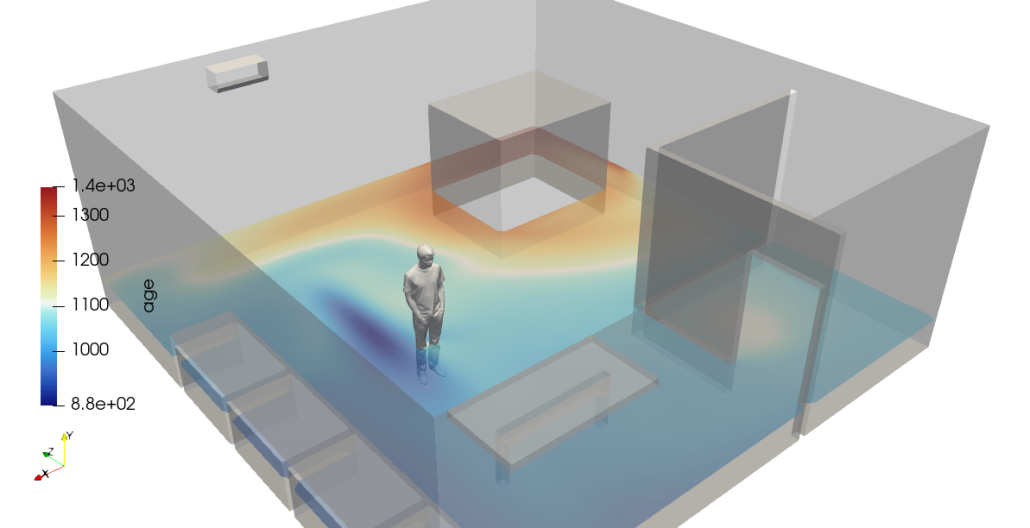
Beyond thermal comfort, indoor air quality is assessed using the concept of Air Age. Air Age represents how long air has remained inside a space and serves as an indicator of ventilation effectiveness. Fresh, well-distributed air corresponds to low Air Age values, while high values indicate stagnant regions where air is not being properly renewed. tensorHVAC-Pro provides detailed Air Age visualization, helping engineers evaluate ventilation performance and ensure that fresh air reaches all occupied areas. This is particularly important in applications such as offices, hospitals, and cleanrooms, where air quality is critical.
One of the key strengths of tensorHVAC-Pro is its ability to integrate all of these parameters into a single workflow. Instead of analyzing velocity, temperature, comfort, and air quality separately, engineers can evaluate them simultaneously within the same simulation. This holistic approach provides a complete understanding of indoor environmental performance and supports more informed design decisions.
In practice, the workflow is straightforward. Engineers import the building or room geometry, define airflow conditions and heat loads, and run the simulation. The software then generates visual and quantitative results for velocity, temperature, PMV, PPD, draft rate, and Air Age. Based on these results, the design can be refined by adjusting diffuser placement, modifying airflow rates, or improving ventilation strategies. This iterative process allows engineers to identify and resolve potential issues early, reducing costly revisions during construction.
By providing accurate, visual, and easy-to-interpret insights, tensorHVAC-Pro enables engineers to move beyond simplified assumptions and manual calculations. It bridges the gap between advanced CFD accuracy and practical HVAC design, ensuring that indoor environments are not only functional but also comfortable and energy efficient.