
FEA Consulting Service
PT Tensor team has been delivering mechanical design service since 2013 with speciality in FEA Simulation
Finite Element Analysis for Engineering Design and Structural Evaluation
Finite Element Analysis (FEA) consulting services provide numerical simulation of structural behavior under various loading conditions. FEA enables engineers to evaluate stress distribution, deformation, fatigue life, and stability of mechanical components and structures before physical prototypes are manufactured.
Through computational modeling, complex engineering systems can be analyzed under realistic operating conditions such as mechanical loads, thermal stresses, dynamic forces, or nonlinear material behavior. This allows engineers to identify potential failure points, optimize designs, and improve product reliability.
FEA simulation is widely used across many industries including manufacturing, energy, aerospace, marine engineering, heavy equipment, and infrastructure engineering.
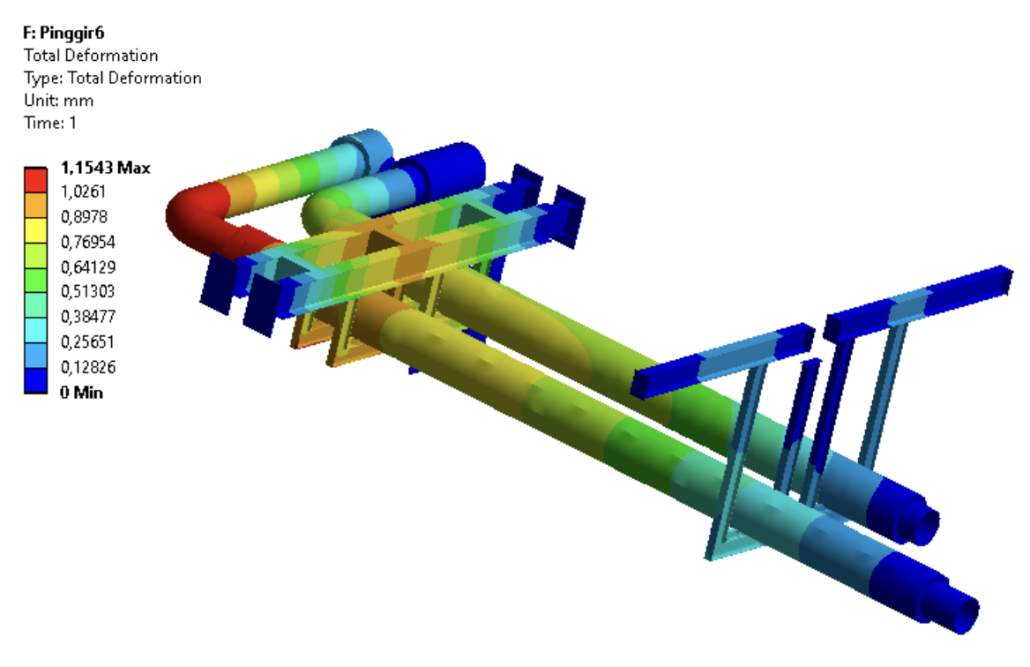

Engineering Problems Solved Using FEA
Finite Element Analysis is commonly applied to evaluate structural performance in situations where analytical calculations are insufficient.
Typical engineering problems analyzed using FEA include:
-
stress concentration in mechanical components
-
deformation under static loads
-
structural stability and buckling
-
fatigue failure due to cyclic loading
-
thermal stresses caused by temperature gradients
-
contact forces between interacting components
-
structural response to dynamic loads
By understanding these phenomena, engineers can improve design safety and performance.
Types of FEA Analysis
Different engineering problems require different types of structural simulations. FEA consulting services can include various forms of analysis depending on the design objectives.
Static Structural Analysis
Static structural analysis evaluates stresses and deformation caused by steady loads applied to a structure.
This type of analysis can determine:
-
stress distribution in structural components
-
deformation of mechanical systems
-
load-bearing capacity of structures
-
safety factors for design verification
Static analysis is widely used in the design of mechanical equipment and structural systems.
Nonlinear Structural Analysis
Many engineering systems exhibit nonlinear behavior due to large deformation, contact interactions, or nonlinear material properties.
Nonlinear FEA can analyze:
-
large deformation structures
-
elastoplastic material behavior
-
rubber and hyperelastic materials
-
contact between multiple components
Nonlinear analysis is often required for complex engineering designs.
Fatigue and Life Assessment
Many mechanical components are subjected to cyclic loading during operation. Over time, these repeated loads may lead to fatigue failure.
Fatigue analysis can evaluate:
-
fatigue life of structural components
-
crack initiation risks
-
durability under repeated loading conditions
This type of analysis is commonly used in machinery and structural systems.
Thermal Stress Analysis
Temperature variations can induce thermal expansion and stresses within engineering components.
Thermal FEA simulations can evaluate:
-
temperature distribution in structures
-
thermal expansion effects
-
stresses caused by thermal gradients
Thermal analysis is particularly important for high-temperature equipment and energy systems.

