
Optimize HVAC Design in Residential Building using tensorHVAC-Pro
Designing HVAC systems for residential buildings requires a balance between comfort, energy efficiency, and cost. Unlike large commercial or industrial systems, residential HVAC must operate efficiently under varying daily conditions while ensuring consistent indoor comfort for occupants. However, traditional design approaches often rely on simplified calculations that may not fully capture real airflow behavior inside homes. This can lead to issues such as uneven temperatures between rooms, poor air circulation, or inefficient energy usage.
The first step in optimizing HVAC design in residential buildings is understanding thermal load distribution. Each room may experience different heating and cooling requirements depending on factors such as orientation, window size, insulation, and occupancy. Proper load calculation ensures that the HVAC system is neither undersized nor oversized. However, even with accurate load calculations, achieving uniform comfort throughout the house depends heavily on how air is distributed.
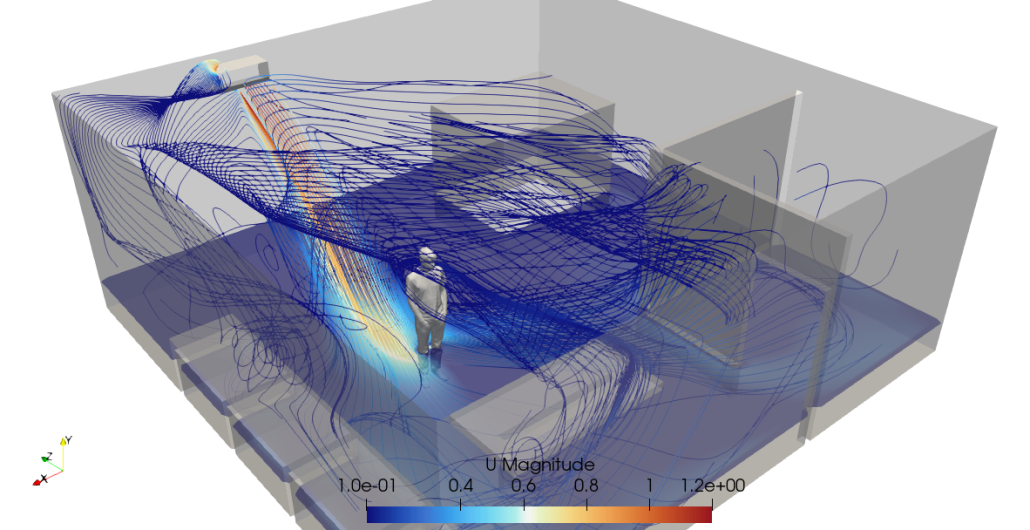
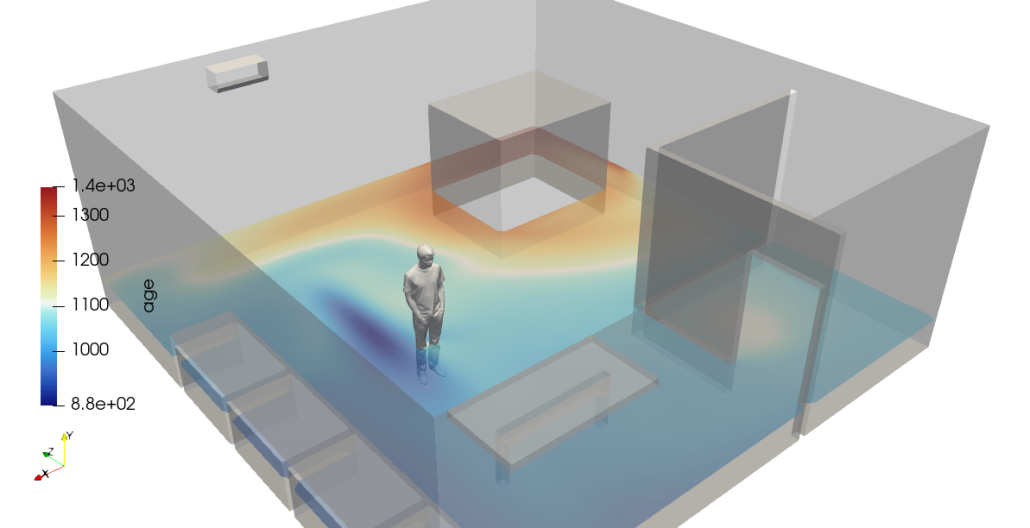
Air distribution is one of the most common challenges in residential HVAC systems. Rooms located farther from the air handler may receive less airflow, while others may experience excessive air velocity. Poor diffuser placement or duct design can create hot and cold spots, leading to discomfort for occupants. In multi-room layouts, airflow interaction between spaces further complicates the system performance.
This is where tensorHVAC-Pro provides a significant advantage. By using Computational Fluid Dynamics (CFD), engineers can simulate how air flows through residential spaces, including living rooms, bedrooms, kitchens, and hallways. The software enables visualization of airflow patterns, temperature distribution, and velocity fields, helping engineers understand how air actually behaves inside the home rather than relying solely on theoretical assumptions.
With tensorHVAC-Pro, engineers can optimize diffuser placement and duct layout to achieve more uniform air distribution. For example, simulations can show whether air from a ceiling diffuser reaches the occupied zone effectively or if it bypasses certain areas. Adjustments can then be made to improve airflow coverage and eliminate stagnant zones. This leads to more consistent temperatures across different rooms and improved occupant comfort.
Thermal effects within residential spaces can also be analyzed using CFD. Heat gains from sunlight, appliances, and occupants can create localized temperature variations that influence airflow patterns. tensorHVAC-Pro allows engineers to include these heat sources in simulations, providing a more realistic representation of indoor conditions. This helps ensure that the HVAC system performs effectively under real-life scenarios.
Energy efficiency is another key benefit of optimization using simulation. By understanding airflow behavior and temperature distribution, engineers can avoid overdesigning the system and reduce unnecessary energy consumption. Optimized airflow means that the HVAC system can achieve desired comfort levels with lower airflow rates or more efficient operation, leading to reduced energy costs for homeowners.
In addition to improving performance, simulation-based design reduces uncertainty. Engineers can test multiple design scenarios virtually, such as different diffuser types, airflow rates, or duct configurations, before finalizing the design. This minimizes the risk of post-installation issues and costly adjustments.
By integrating CFD into residential HVAC design, tensorHVAC-Pro enables engineers to move beyond traditional assumptions and design systems based on real airflow behavior. This approach leads to improved comfort, better air distribution, enhanced energy efficiency, and more reliable HVAC performance in modern residential buildings.