
HVAC Thermal Comfort Parameters (PMV, PPD, DR, Air Age)
In the design and evaluation of indoor environments—especially in HVAC engineering—several key indices are used to quantify thermal comfort and air quality. Among the most widely used are Predicted Mean Vote (PMV), Predicted Percentage of Dissatisfied (PPD), Draught Rate (DR), and Air Age. These parameters help engineers and designers ensure that indoor spaces are not only thermally comfortable but also healthy and energy efficient.
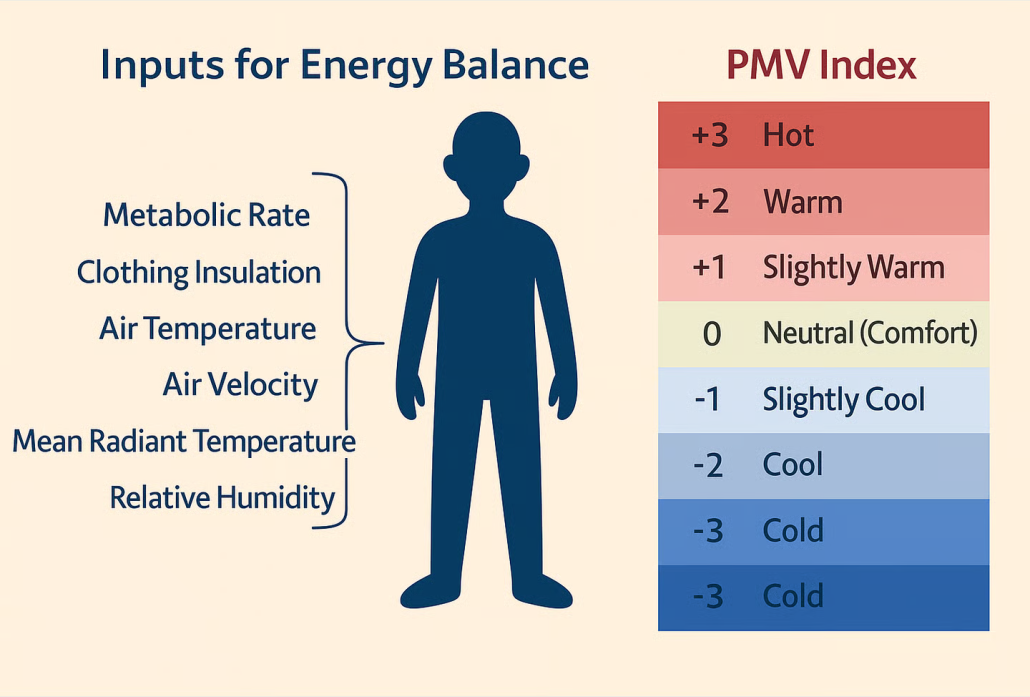
Predicted Mean Vote (PMV) is a thermal comfort index developed by Ole Fanger that predicts the average thermal sensation of a large group of people. It is based on a scale ranging from -3 (cold) to +3 (hot), with 0 representing thermal neutrality. PMV takes into account several environmental and personal factors, including air temperature, mean radiant temperature, air velocity, humidity, clothing insulation, and metabolic rate. By combining these variables, PMV provides a comprehensive assessment of how occupants are likely to perceive the thermal environment.
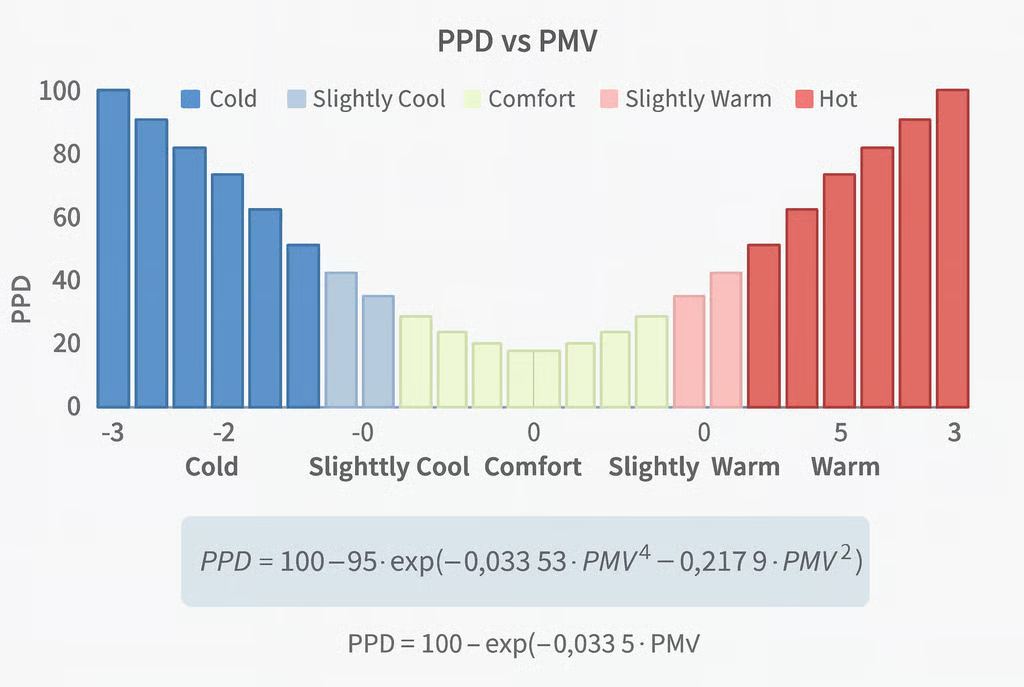
Closely related to PMV is the Predicted Percentage of Dissatisfied (PPD), which estimates the percentage of people who are likely to feel thermally uncomfortable in a given environment. Even when PMV is at neutral (0), not everyone will be satisfied; typically, a minimum of about 5% of occupants may still feel discomfort. The PPD index is derived mathematically from PMV and provides a more intuitive measure for designers, as it directly indicates the expected dissatisfaction level. Standards such as ISO 7730 and ASHRAE 55 often specify acceptable ranges of PMV and PPD for indoor environments.
Draught Rate (DR) is another important parameter that evaluates local thermal discomfort caused by unwanted cooling of the body due to air movement. Unlike PMV and PPD, which assess overall thermal comfort, DR focuses on localized effects, particularly in areas such as the neck, ankles, or back. DR depends on air velocity, turbulence intensity, and air temperature. High air speeds, especially in cooler environments, can significantly increase the draught rate and lead to discomfort even if the overall PMV is acceptable. Therefore, controlling air distribution and diffuser design is critical in HVAC systems.


Air Age, or the age of air, is a concept used to assess indoor air quality and ventilation effectiveness. It represents the average time that air has spent inside a room since entering through the ventilation system. A lower air age indicates fresher air and better ventilation performance, while a higher air age suggests stagnation and potential accumulation of contaminants. Air age is often evaluated using computational fluid dynamics (CFD) simulations or tracer gas experiments, making it a valuable metric in the design of ventilation systems for spaces such as offices, hospitals, and cleanrooms.
Together, PMV, PPD, DR, and Air Age provide a comprehensive framework for evaluating both thermal comfort and indoor air quality. PMV and PPD address overall thermal sensation and satisfaction, DR captures local discomfort due to airflow, and Air Age reflects ventilation efficiency. By integrating these parameters into HVAC design and analysis, engineers can create indoor environments that are not only comfortable but also healthy and energy efficient.
To go beyond theoretical evaluation and truly understand how these comfort parameters behave in real spaces, engineers increasingly rely on Computational Fluid Dynamics (CFD). Through CFD, detailed distributions of temperature, velocity, turbulence, and contaminant transport can be analyzed, allowing accurate prediction of PMV, PPD, DR, and Air Age within complex geometries. This is where tensorHVAC-Pro becomes highly valuable—providing a specialized CFD-driven platform tailored for HVAC analysis. With its capability to simulate airflow patterns, thermal fields, and ventilation performance, tensorHVAC-Pro enables engineers to optimize indoor environments with confidence, ensuring both comfort and air quality are achieved efficiently.