
Fluid Mechanics Governing Equations
Some books define the three governing equations of fluids as the Navier-Stokes equations. However, it generally defined that the Navier-Stokes equations only represent the momentum equation. We will use the “NS equation” in the rest of this book as momentum equation.
Below are explanations for each of the governing equations of fluid mechanics:
Mass Conservation equation (continuity)
The continuity equation can be defined as follows:
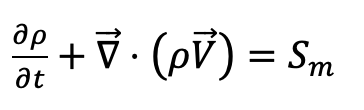
Equation above is the general law of mass conservation equation that applies to compressible and incompressible flows.
Where is the source term for added mass. For example, in modeling the dispersion of the second phase (e.g., evaporation) or a source defined as desired.
Momentum conservation equation (Navier-Stokes)
The Navier-Stokes equation has some forms; this is one of the “popular” Navier-Stokes equation:

With tau is the stress tensor, p, rho, g, F, and respectively, refers to pressure, gravitational load (from within the fluid itself), and external forces such as interactions with other dispersed phases or porous media.
The stress tensor itself is defined as follows:

With miu is molecular viscosity, and I is a unit tensor
Energy equation
The conservation of energy equation in fluid flow is defined as follows:

With E, h, and J respectively are total energy, enthalpy, and mass flux.